
“If you make a purchase using our provided links, we may receive a commission. Learn more here.
Dehumidifiers are an excellent tool to have in your arsenal for creating a comfortable home environment.
I am often asked which dehumidifier I recommend, but it’s a bit more complicated than that.
With a range of sizes and uses, it’s really important for me to understand my customers’ specific needs to help them find the right fit.
I’ve created this guide of everything that I consider, so that you can find the right dehumidifier for your own needs. Let’s get started!
Aim for an indoor relative humidity between 40% and 50%
Goal | Below 40% | 40% - 50 % | Over 60% |
|---|---|---|---|
Best for total home comfort | |||
Ideal for allergy sufferers | |||
Manage asthma symptoms | |||
Avoid respiratory illnesses | |||
Stop the spread of viruses | |||
Negate static electricity | |||
Discourage bacteria and mold growth | |||
Fight dust mites |
Understand the different types of dehumidifiers available
All dehumidifiers work to remove moisture from the air, but there are two types of dehumidifiers: refrigerant and desiccant.
These work quite differently from each other, but both options have their merits.
Refrigerant dehumidifiers are the most common type
Best For:
Related article: Dehumidifiers versus AC units
Most dehumidifiers for home use will be refrigerant dehumidifiers.
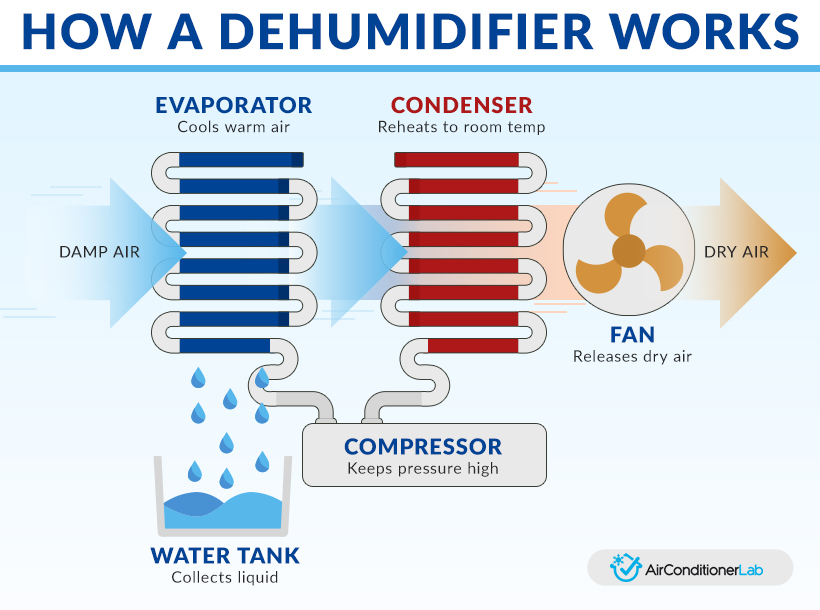
Refrigerant dehumidifiers work a lot like air conditioners.
- They use a fan to pull in hot humid air and pass it over the cool evaporator coil.
- The air is cooled and shrinks down to its dew point where the vapor in the air condenses into water droplets.
- These droplets are then collected in a container or drained away.
- The air is now cooler and its volume smaller which means it’s at 100% humidity.
- The fan now forces that cold, wet air through the hot condenser coil to give it a gentle warm-up which expands the air and reduces its humidity level before it's released back into your room, making the space feel more comfortable.
This process continues until the room reaches the desired humidity level and is turned off by the humidistat.
What I appreciate about most modern refrigerant dehumidifiers is the on-board humidistat. This handy device lets you set your desired relative humidity (RH) level.
The dehumidifier will then only kick on the compressor when the humidity rises above your set point, ensuring efficient operation and consistent comfort.Nearly all traditional portable air conditioners have this refrigerant driven dehumidification built-in, so for my clients also seeking a cooling option, I often look to these portable ACs first.
Related article: Customize your dehumidifier settings
Advantages and disadvantages of refrigerant dehumidifiers
Advantages
Disadvantages
Related article: Dehumidifiers made in the US
Desiccant dehumidifiers are popular for low-temperature operation
Best For:
Desiccant dehumidifiers are generally more industrial looking, and are also marketed as desiccant dryers because of their efficiency at drying out large, damp areas.
I frequently recommend these models for use after customers have had flooding or a large pipe leak.
These dehumidifiers work by using a fan over a large desiccant wheel, sucking in moisture literally like a large sponge, and sending dry air back out into the room.
To allow the desiccant to keep retrieving moisture without reaching its full capacity, the wet air passes over a heating element, keeping the desiccant dry enough to keep working, and the humid air expelled through as exhaust, usually through a window.
Homemade dehumidifiers, such as those using silica gel, are also considered desiccant dehumidifiers.
Advantages and disadvantages of desiccant dehumidifiers
Advantages
Disadvantages
How to decide between desiccant and refrigerant dehumidifiers by goal
Best for: | Desiccant dehumidifier | Refrigerant dehumidifier |
|---|---|---|
Cost |
| Winner |
Powerful dehumidification |
| Winner |
Overall Life Span |
| Winner |
High temperature use |
| Winner |
Drying speed |
| Winner |
Energy efficiency |
| Winner |
Quiet operation | Winner |
|
Low maintenance | Winner |
|
Ease of setup | Winner |
|
Size and portability | Winner |
|
Low temperature use | Winner |
|

Size the dehumidifier properly
Unlike home appliances like portable air conditioners and home air purifiers that are sized by room or home size, there is a bit more that goes into properly sizing a dehumidifier.
This is because we also need to take into consideration how damp the current room area is, and the current relative humidity in the part of the country you live in.
Before shopping for a dehumidifier, I recommend using a humidistat to measure the current moisture levels in your target area. You can also look at the average moisture content of the area you live in.
Then, take a close look at the table I’ve included below in the next section.
The coverage area is often mentioned
Most dehumidifiers will market their coverage area, and this is a good place to start in determining your size, but won’t be the only determining factor.
For example, this Amana dehumidifier can cover up to 800 square feet and collect up to 35 pints of moisture per day.
In comparison, this Amazon Basics dehumidifier can also collect up to 35 pints of moisture per day, but is listed for areas of up to 2500 square feet.
It all comes down to your specific moisture removal needs, which is listed as pints per day (or PPD).

What is pints per day, and how much do you need?
Pints per day (PPD) is that maximum amount of moisture that the dehumidifier can remove from an area in a 24 hour period.
The caveat is that not all dehumidifiers have a drainage basin that matches their PPD abilities.
For example, this Black & Decker model can remove 22 pints of moisture per day, but it’s collection basin is only 6.4 pints (0.8 gallons).
That means you’ll either need to install continuous drainage or empty the reservoir regularly, which is a factor you’ll also need to consider in your purchasing decision.
Here’s a chart I made to help you figure out what PPD rating you should look for when shopping around, based on your home’s current moisture levels.
Current Home Humidity Levels (RH) | 300 square feet | 500 square feet | 800 square feet | 1200 square feet |
|---|---|---|---|---|
50-60% | 20 pints | 25 - 30 pints | 35 - 40 pints | 50 pints |
60-70% | 20 pints | 25 - 30 pints | 35 - 40 pints | 50 pints |
70-80% | 25 pints | 35 pints | 45 pints | 55 pints |
80%-100% | 25 - 30 pints | 35 - 40 pints | 45 - 50 pints | 60 pints |
For areas larger than 1200 square feet, I ask that you consider whether an area is sealed or not.
There is a big difference in dehumidifying a tightly sealed home versus its unsealed crawl space.
Dehumidifiers in tightly sealed spaces can typically cover more area than dehumidifiers in unsealed areas like crawl spaces.* Here is a chart showing PPD and how I would size them based on the area.

| 70 - 80 PPD | 80 - 100 PPD | 100 - 155 PPD |
|---|---|---|---|
Unsealed | Up to 1800 sq ft | Up to 2200 sq ft | Up to 3600 sq ft |
Tightly Sealed | Up to 2600 sq ft | Up to 3000 sq ft | Up to 4400 sq ft |
*Typically, if an area is unsealed, I reduce the coverage area of the dehumidifier for a large area by 800 square feet.
Related article: Learn the optimal humidity level for crawl spaces

Considerations for replacing your current dehumidifier
In 2020, the US Department of Energy (DOE) changed their testing standards regarding dehumidifiers.
Prior to 2020, dehumidifiers were tested in 80F environments. Now, they are tested in 65F because that is considered more of a “real world” scenario.
The models still run exactly the same. Because the temperature is cooler, the pints per day has decreased overall to match the new standard of moisture removal at 65F.
If you’re replacing a model that was purchased prior to 2020, here’s a guide to help you find the right size:
Dehumidifier PPD is measured by testing standards
Pre-2020 Pint Capacity | Post-2020 Pint Capacity |
|---|---|
30 pints | 20 pints |
40 pints | 25 pints |
50 pints | 30 pints |
60 pints | 35 - 40 pints |
70 pints | 45 - 50 pints |
90 pints | 55 - 60 pints |
100 pints | 70 pints |
120 pints | 100 pints |
140 pints | 115 pints |
160 pints | 135 pints |
200 pints | 170 pints |
Three different major size categories
Room dehumidifier:
Most dehumidifiers you’ll find on the shelf at a big box store will be considered room dehumidifiers, even if they cover a large area.
These devices are small to medium sized, portable, and can be used in a standard wall outlet.
Whole house dehumidifier:
Whole house dehumidifiers attach to your home’s HVAC system to manage humidity levels throughout your entire home.
These are larger units, typically over 100 pounds, that are installed permanently in your home’s basement, attic, or crawlspace.
Commercial dehumidifiers:
Commercial models are large, portable consoles that often have a wheel base (desiccant type). They are great for big jobs, but are often very expensive, large, and loud.
Feature | Room Dehumidifer | Whole House Dehumidifier | Commercial Dehumidifier |
|---|---|---|---|
Coverage Area | 500-2,000 sq ft | Entire home (3,000-5,000+ sq ft) | 5,000+ sq ft |
Portability | High (easily movable) | Fixed installation | Moderate (portable but large) |
Power Source | Standard outlet (110V) | Integrated with HVAC system | 220V or higher |
Noise Level | Low to moderate | Low | High |
Maintenance | Regular filter and tank cleaning | Occasional HVAC service | Frequent maintenance |
Price Range | $100-$300 | $1,000-$2,500+ | $1,500-$4,000+ |
Consider the operating temperatures
Refrigerant dehumidifiers have limitations
The ideal operating temperature for most refrigerant dehumidifiers is between 60F and 85F. Refrigerant dehumidifiers can often freeze up if used in environment colder than their stipulated range.
With these models, there are three things I like to consider:
Look for low temperature operation
Some refrigerant dehumidifiers are marketed as having “low temperature operation,” meaning that they can work well even below the ideal temperature range.
However, I always remind my customers that the threshold here is still above freezing.
For example, this Honeywell dehumidifier can operate in conditions as low as 41F.Choose a unit with an anti-frost function
I have found that the wording around “frost functions” in dehumidifiers can be confusing, and in some cases, even misleading to consumers.
Nearly all modern refrigerant dehumidifiers have anti-frost protection.
This simply means that there are sensors within the model that will automatically shut the unit off at the first sign of frost in order to protect the coil from freezing over.
Some models, like the Pro Breeze 50 pint dehumidifer, have a built-in defrosting function that will gently heat the coil so that it doesn’t freeze over.Don’t forget upper limitations
If I have a customer looking to add a dehumidifier to a space without air conditioning, especially a garage prone to humidity, I like to look at the upper limits on the dehumidifier’s specifications.
All good dehumidifiers come with thermal overload protection (performance enhancers) as a standard safety feature, meaning the dehumidifier will not function above a certain threshold.
For models like the AprilAire E100, this upper limit is an impressive 104F.
However, some models have a thermal overload switch at temperatures as low as 89F, so this is very important to check for very warm places.

ACLAB Note:
Whole house dehumidifiers have a much wider operating range than room dehumidifiers. For example, the Honeywell TrueDRY home system can operate in temperatures ranging from 32F - 135F.
Desiccant dehumidifiers are more suitable for cold temperatures
Desiccant dehumidifiers have a wide operating range, with some operating in as temperatures as low as -4F.
These models are the right choice for almost all commercial and industrial situations, including:
This ECOR Pro model has an operating range of -4F to 104F, and can remove up to 150 pints of moisture per day.
Look at the drainage options available
Manual drainage
Manual drainage on a dehumidifier is pretty self explanatory, and simply means that you will need to physically empty the collected water and dump it down a sink or other drain.
The most important consideration here is knowing how large the collection tank is in comparison to the PPD.
Typically, these water basins are smaller than the model’s PPD capacity, which can make emptying the unit a hassle.
For example, this Shinco dehumidifier can remove up to 30 pints of moisture per day, but the collection tank is only 2.64 pints.This means that in order to collect the full 30 pints, you would need to manually drain the bucket eleven times throughout the day.
ACLAB Note:
Nearly every modern room dehumidifier will have some sort of manual drainage tank. This is especially useful if you don’t have a drain nearby or will only be using the dehumidifier for a short time. Many room dehumidifiers will also have auto-drainage options (usually marketed as continuously drainage).

Auto drainage with gravity drain
Sometimes, to avoid frequent manual draining, a room dehumidifier will be fitted with an optional condensate line to allow continuous draining.
Some models come with a several foot line that can be connected for gravity draining.
This means that the dehumidifier must be placed at a higher elevation than the line, so that the water can naturally flow down.
Gravity drains can be fed into a larger bucket to be manually drained, or directly into a drain line.
The risk here is that if you forget about the external bucket, it has the potential to overflow because the continuous drain setup will not alert the dehumidifier that the manual bucket is full.
If the gravity drain isn’t working well for you, or you require water to be moved up and out, most dehumidifiers can also be fitted with a third-party pump.
These small units generally turn on when the auto-full sensor of the dehumidifier is engaged, and work to quickly remove water without your assistance.
Auto drainage with built-in pump
Models like the Midea Cube MAD50S1QWT have a built-in pump that allows water to be pumped up and out through a window or to a sink or drain.
Though these models are often more expensive, room dehumidifiers with a built-in pump are your best bet if continuous drainage is important to you.
Whole house dehumidifiers also have a built-in pump. These set-it-and-forget-it models work to manage your home’s humidity 24-7.
For example, the AprilAire E130 Pro can be positioned right over a drain, or it can run a water line to a condensate drain, similarly to how your home air conditioner expels water.
I like to remind my customers that whole house dehumidifiers do not usually come with a drain hose, and this is sold separately.
This is due largely to the fact that depending on your home setup, you could require a 1 foot line or a 20 foot line.
For maximum water removal, models like the Ecor Pro170LGR can pump water as far as 40 feet away from the unit at a rate of 170 pints per day.
I have used this model in hurricane zones where flooding is prevalent. They are expensive, but a well-worthy investment in high risk areas.
Related article: Top-rated dehumidifiers with a built-in pump
Exhaust-only condensation removal
Desiccant dehumidifiers like the ECOR Pro Model expel water differently than refrigerant models.
Instead of collecting water or continuously draining it, these models use a heating element to turn the water into what is called a “nano-mist,” which is then expelled as humidified air through an exhaust pipe.
That’s why these commercial models must be properly ventilated through a window or door to the outside.
ACLAB Note:
Many dehumidifiers come with a combination of drainage options. For instance a dehumidifier may have a detachable tank for manual drainage and at the same time also have a built-in pump for auto-drainage.
Can you drink water from the dehumidifier's tank?
Keep the noise levels in mind
Dehumidifiers work similarly to refrigerators, in that they use a compressor and fan to run, naturally creating noise.
The noise of dehumidifiers can range anywhere from 30 dB to over 80 dB in industrial models.
Unfortunately, I’ve found that dehumidifier brands don’t always disclose this information, so you may need to do a bit of digging to find a unit that matches your needs.
Related article: Favorite quiet dehumidifiers
The Waykar CTH30A has a running noise of 33 dB. This is similar to a window air conditioner and is ideal for bedrooms or quiet offices.
The Abestorm 270 Pint model is much louder at 63 dB, which is comparable to a hair dryer.
On a large worksite this probably wouldn’t be too bothersome, but you likely wouldn’t be able to have a phone conversation next to the unit.
Whole house dehumidifiers typically fall somewhere between the noise levels of room and commercial models. However, I always tell my customers to consider the dehumidifier placement.The 53 dB sound rating of the AprilAire E130 likely won’t disturb homeowners as all, as the unit is placed in the basement, crawlspace, or attic, much like a central air conditioner has a loud outdoor unit.
Here are how some of my favorite dehumidifiers compare, both to each other and to other common household appliances.
Dehumidifier or home appliance | Low noise (dB) | High noise (dB) |
|---|---|---|
Desk fan | 30 | 30 |
Pro Breeze PB-2 | 33 | 33 |
BuBlue DH1 | 36 | 36 |
Midea Cube | 42 | 49 |
hOmeLabs HME20006N | 50 | 59 |
AprilAire E130 (whole house) | 53 | 53 |
AprilAire E100 (whole house) | 55 | 55 |
Alor Air Storm LGR Extreme | 58 | 58 |
Abestorm 270 Pint | 63 | 63 |
Hair dryer | 80 | 90 |
Electrical considerations and cost to run
Expected cost to run per day, month, and year
For those interested in all the ins-and-outs of the details, I have written an entire guide on how much it costs to run a dehumidifier based on wattage.

The takeaway is that dehumidifiers do not cost that much to run, with most room models costing only 3 to 6 cents per hour.
You can calculate how much it will cost to run any dehumidifier for one hour by using this formula:
Charge per kilowatt x number of kilowatts used = hourly cost
The national kWh (kilowatt per hour) price is $0.13, so I’m using that in my formula, but you can find your exact kWh on your electricity bill or by using tools like Energy Bot.
For my example, I will use this GE dehumidifier that runs with 520 watts and can remove up to 50 pints per day:
0.13 × (520 ÷ 1000) = 0.0676 ≈ 7 cents per hour
Here’s a chart I created to give you a general idea of how much a dehumidifier will cost to run over time, based on standard wattages:
kWh price | Wattage | Price Per Day | Price Per Month (30 Days) | Price Per Year |
|---|---|---|---|---|
$0.13 | 100 | $0.104 | $3.12 | $37.44 |
$0.13 | 200 | $0.026 | $6.24 | $74.88 |
$0.13 | 300 | $0.313 | $9.36 | $112.32 |
$0.13 | 400 | $0.416 | $12.48 | $149.76 |
$0.13 | 500 | $0.52 | $15.60 | $187.20 |
$0.13 | 600 | $0.624 | $18.72 | $224.74 |
$0.13 | 700 | $0.728 | $21.82 | $262.08 |
$0.13 | 800 | $0.832 | $24.96 | $299.52 |
*kWh of $0.13 may be different in your area. Check your utility bill for exact numbers.
Do you need a dedicated circuit for dehumidifiers?
A dedicated circuit means that the appliance (in this case, dehumidifier) is the only device on the circuit.
If your toaster and coffee maker share an outlet, they share a circuit.
The average 15 amp circuit can handle up to 1800 watts.
Most localities recommend placing any appliance over 1000 watts on a dedicated circuit, which is in accordance with the National Electric Code (NEC).
I say to play it even safer than that, and consider putting any appliance over 800 watts on a dedicated circuit.Most room dehumidifiers will be able to share a circuit with other electronics, but larger units, like the 830 watt Perfect Aire, should be on a dedicated circuit for best results.
Choose a unit with an energy star rating
Like many of our home appliances, some dehumidifiers are Energy Star Certified.
The EPA vets this models through vigorous efficiency tests, and the winners become Energy Star Certified.
In the dehumidification category, these units must be at least 13% more efficient than the standard model. This translates to a lower running cost for you.
Some of my favorite Energy Star rated dehumidifiers include:
Other important features to consider
A unit with a humidistat
Most modern room dehumidifiers have a built-in hygrometer that will show the current humidity levels of the immediate area.
This is a handy feature that allows you to adjust the settings based on what you’re seeing.An upgraded feature is the humidistat.
This feature essentially shows you the current humidity levels like a hygrometer, but allows you to pick your ideal humidity percentage, and will adjust the settings on the dehumidifier automatically to achieve it, as in this hOmeLabs model.
| Hygrometer | Humidistat |
|---|---|---|
Purpose | Measures humidity levels | Controls humidity levels |
Measurement capability | Gives real-time readings | Monitors and regulates based on set point |
Control capability | No direct control function | Can adjust devices |
Accuracy | High accuracy for readings | Moderate accuracy, focused on regulation |
Typical use | Monitoring indoor humidity | Automatic regulation of HVAC devices |
Cost | Low | Mid to high |
Smart and Wi-Fi controls
Some newer models are Wi-Fi compatible and can be controlled via app or even with voice commands by enabling Amazon Alexa or Google Home.
This is not a common feature, though, and is primarily seen in tech-forward brands like Midea.Programmable timer
A programmable timer is a nice feature, but for room dehumidifiers set on auto-mode, it’s probably not necessary.
Instead, I find timers to be the most helpful on job sites.
I like being able to set up the ALORAIR Storm on a timer of about 8 to 10 hours and getting on with my day without much thought.
How much do you want to spend?
Dehumidifiers are more complicated appliances than humidifiers that add moisture to your home, and their internal components (the compressor and coil) make them more expensive.
Room dehumidifiers can range from around $100 for very small models, to upwards of $400 on average, for models with advanced features like the Frigidaire 50 pint smart dehumidifier.
Whole house dehumidifiers are much more of a cost upfront, and can range from options coverage modest areas under 2000 square feet costing around $1600 like the Innovative WH85, to large systems spanning over 4500 square feet.
Far fewer brands sell whole house dehumidifiers, so they have the opportunity to market much more expensively.
Commercial dehumidifiers are trickier to price out, and your budget will need to be determined largely by the job at hand.
I have worked with smaller models perfect for crawl spaces like the Abestorm Guardian SN35P, costing about $475 upfront, and industrial sized models like the Dry-Eaz LGR 3500i, which can remove up to 30 gallons of moisture per day but cost about $5000 upfront.This chart illustrates how quickly the price can increase for whole house and commercial models.

This next chart highlights the efficiency of different dehumidifiers based on their Pints Per Day (PPD) per $1 invested, helping you understand which model might offer the best value for your budget.
While this cost-efficiency measure is useful, it's important to consider other factors such as the speed of moisture removal and the type of dehumidifier, as they can significantly impact the overall performance and suitability for your needs.

Bonus! Don’t forget maintenance requirements

At a minimum, here are my top three considerations for keeping your dehumidifier in tip-top shape.
Clean the water collection basin regularly
I recommend emptying the tank after every single use, even if the dehumidifier isn’t collecting the maximum amount of water.
Leaving water stagnant will create a breeding ground for biofilms, and will allow bacteria and mold to form.
Even if the tank looks clean, I recommend washing it out with warm, soapy water at least once a month.
Change the air filters
I’ve talked with many people who are surprised to learn that dehumidifiers have air filters, but most do, as they protect the inner motor from becoming covered in dust and debris.
I recommend cleaning your air filter out with soap and water every six months.
Store completely dry
In the off-season, make sure that your dehumidifier is stored completely dry, including the drainage hoses.
This will go a long way in preventing mold growth and keeping your unit functioning properly.
I also recommend storing at room temperature to protect the coil from extreme conditions.
Related article: Lifespan of dehumidifiers