
“If you make a purchase using our provided links, we may receive a commission. Learn more here.
As an expert, I've fitted and used my share of portable ACs over the years.
One question that often pops up is, "Can you lay a portable AC on its side?" It's a practical concern, especially when you're moving or storing it.
The answer is that you should avoid laying your portable AC. I'll cover the reasons why in this guide.
Key takeaways
Reasons not to lay your portable AC on its side (Even when storing)
Laying your portable AC on its side, even just for storage, is a no-go for several key reasons.
From potential oil leaks to internal damage, the risks are real.
Here, I'll break down why keeping your AC upright is more than just a recommendation—it's a necessity.

The AC's compressor can get damaged
Laying a portable AC unit on its side can lead to serious damage to the compressor, the heart of the unit.
The compressor, responsible for circulating refrigerant, relies on oil for smooth operation.
When the unit is not upright, the oil can migrate and prevent the compressor from functioning properly.
I've seen this time and time again, especially when people move units from one home to the next, and the portable AC is transported on its side.
The first tell-tale sign that a portable unit wasn't moved properly is that it fails to cool efficiently.
The brand giant GE recommends that after every move, your portable AC should be stored upright and unplugged for at least 24 hours before you try to use the unit again.
Internal fixtures and AC cooling coils can get damaged
When an air conditioner is laid on its side, internal fixtures, particularly the cooling coils, are at risk of damage.
These coils, vital for the air conditioner’s cooling process, can become misaligned or bent.
In one instance, after rearranging my room, my AC unit accidentally tipped against the wall.
Though it seemed fine initially, I later realized the cooling coils were damaged, impairing the unit's efficiency.
It's a reminder that even a temporary change in position can have lasting consequences.
ACLAB note:
Fixing the cooling coils is not a DIY job. You will need to call the experts.
AC refrigerant can lose its ability to cool
Storing a portable AC on its side for more than a day can cause the refrigerant, crucial for cooling, to lose effectiveness.
The refrigerant needs to flow correctly through the coils, and this flow can be disrupted when the unit is not upright.
A neighbor accidentally once stored his AC sideways over the winter, and when summer came, it just couldn't cool as before.
The refrigerant seemed to have lost its ability to cool efficiently.
Upon researching what happened, I found out that the improper positioning lead to poor circulation, reducing the unit’s cooling capacity.
That’s why it's best to always store and rest your AC in an upright position to maintain its cooling efficiency.
ACLAB note:
A refrigerant leak is also quite common. If you notice any freezing up of the coils when running, there is high chance that the refrigerant has leaked.
Drain water will spill out of the AC
Apart from damaging an air conditioner’s internal parts, laying it on its side can lead to an unexpected mess, as drain water trapped inside may escape.
This water, meant to be drained out properly, can leak into internal components if the unit is not upright.
It's crucial to keep these units standing upright to avoid such spills and ensure they stay clean and functional.
ACLAB note:
Certain portable ACs have auto-evaporating functionality hence you may not find drain water in it
A portable AC on its side can jam the filter drier
Another reason why you shouldn’t lay down portable AC units is that it can cause serious issues with the filter drier, a component critical for absorbing moisture in the system.
Portable air conditioners left unplugged and on their side will result in a jammed filter drier over time.
It's a matter that often goes unnoticed but can severely impair functionality.
Ensuring the AC is upright helps avoid such jams, maintaining the efficiency of the filter drier and the overall health of the unit.
Can you lay portable AC on its side when transporting?
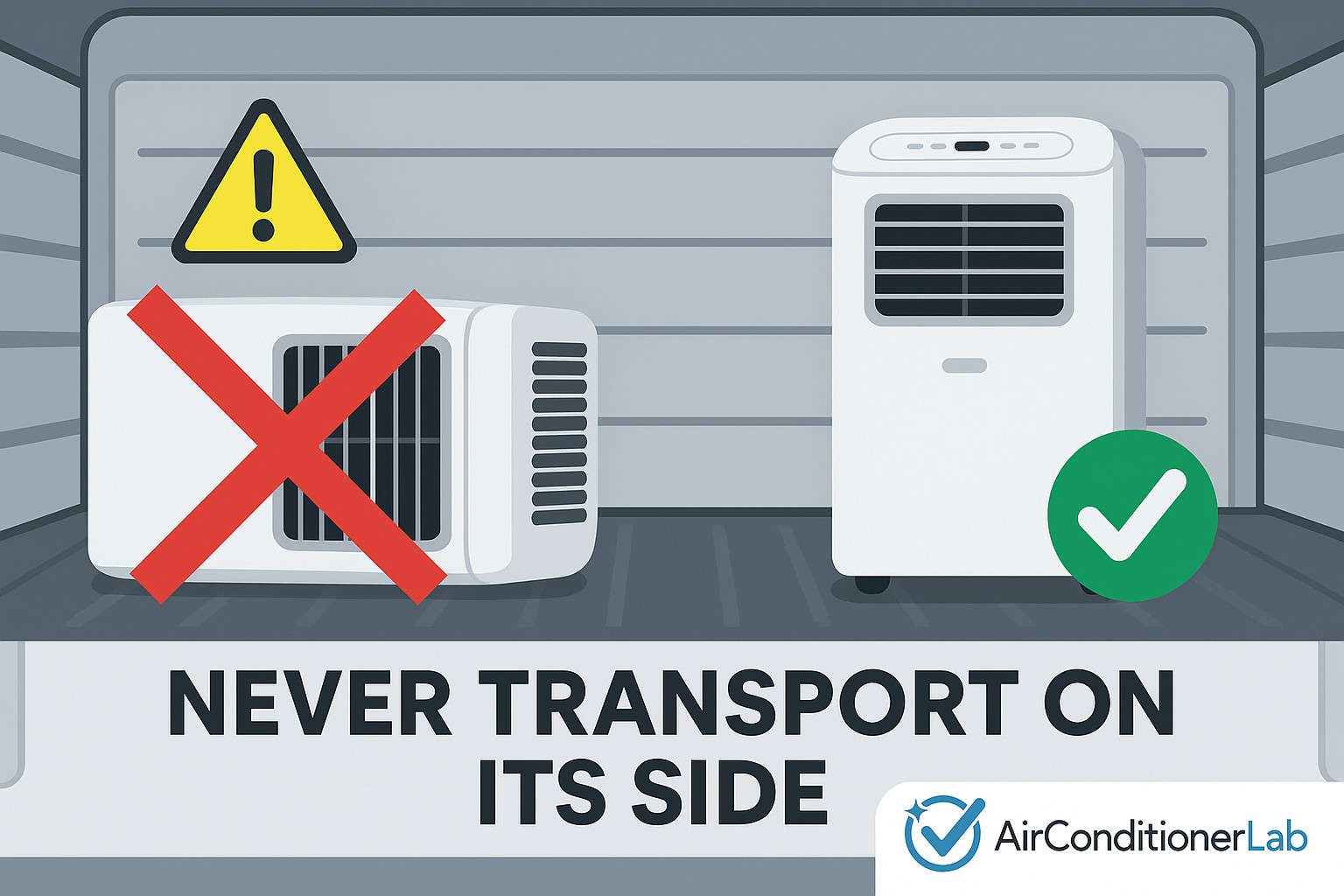
No, it’s not recommended for an air conditioner to lay on its side when being transported.
Doing so risks damaging internal components, even during short transports.
So, only transport a portable air conditioner in an upright position, and keep it secure so it won’t turn sideways or upside down.
How long can you lay it on its side when transporting?
Ideally, you should avoid leaving a portable AC on its side when transporting. If necessary, do it for as short a time as possible and stand it upright quickly. Wait an entire 24 hours before plugging the unit back in.
It's important to minimize the time spent sideways to prevent internal damage or coolant displacement.
How long to keep it upright if it has been laid on its side?
If your portable AC has been laid on its side, leave it upright for at least 24 hours.
You need to wait this long for the internal fluids, particularly the oil, to settle back into place, ensuring the unit functions correctly when you turn it on.
Important note:
There is no guarantee that your portable AC will work properly even if it has been let standing upright for 24 hours. Hence, avoid laying it on its side in the first place.
Safety tips to follow when transporting portable AC
FAQs
What is the correct position of a portable air conditioner?
The correct position for a portable air conditioner is upright, near a window opening, for proper venting. This position ensures optimal performance and prevents damage to the unit.
Does a portable air conditioner have to sit on the floor?
Yes, a portable air conditioner should sit on the floor for stability and proper function. This position ensures portable ACs fit well in the space and operate efficiently.
Can you put a portable air conditioner in a horizontal window?
Yes, you can put a portable air conditioner in a horizontal window as long as it is made for window installation.
Many models come with adjustable window kits that fit various window orientations, providing the answers to diverse installation needs.
If not, then you can also find third party ventilation kits for horizontal or casement windows.